Dr. Nan-Si Li

Dr. Nan-Si Li
Position:Assistant Professor
Science Group:Biomedical technology
Research Interests:Smart Biosensors, Biomaterials, Micro- and Nanomaterials, Biomedical Engineering
E-mail:nansi_li@gs.ncku.edu.tw
Room:89A02
Room Tel:+886-6-2757575#
Laboratory Tel:+886-6-2757575#
| School | Department | Country | Degree | Period |
|---|---|---|---|---|
| National Sun Yat-sen University | Institute of Biomedical Sciences | TW | Ph.D. | 2017~2021 |
| National Sun Yat-sen University | Institute of Medical Science and Technology | TW | Master | 2015~2017 |
| Institute | Position | Period |
| Department of Biotechnology and Bioindustry Sciences, National Cheng-Kung University | Assistant Professor | 2026.08~present |
| Department of Electrical and Electronic Engineering, Imperial College London, UK | Sponsored Researcher | 2025.04~2026.04 |
| Department of Biomedical Engineering, NCKU | Postdoc. | 2022.08~2025.04 |
| Institute of Medical Science and Technology, NSYSU | Postdoc. | 2021.10~2022.07 |
| Kaohsiung Chang Gung Memorial Hospital | Doctoral Researcher | 2020.08~2021.07 |
| Award | Year |
|---|---|
| NCKU Elite Talent Recruitment Subsidy | 2026 |
| Royce@Cambridge Funding | 2025 |
| NSTC Postdoctoral Research Abroad Program | 2025 |
| Academic Medal for Outstanding Paper from Association of Chemical Sensors in Taiwan (Research Group) | 2019-2022, 2025-2026 |
| The Young Author Grant Award in the 15th Asian Conference on Chemical Sensor, Japan | 2024 |
| The 21th National Innovation Award, Taiwan (Research Group) | 2024 |
| The Academic Research Award for Postdoctoral Researchers from NSTC in Taiwan | 2023 |
| The 20th National Innovation Award, Taiwan (Research Group) | 2023 |
| The third Prize Best Young Scholar Oral Presentation Award in the International Conference on Precision | 2023 |
| Nanomedicine in Theranostics & the 2023 Annual Meeting of Taiwan Nanomedicine Society | 2023 |
| The Sakura Science Exchange Program by Japan Science and Technology Agency | 2023 |
| The Distinguished Oral Paper Award in 2022 ICSS, Taiwan | 2022 |
| The Outstanding Doctoral Thesis from NSYSU, Taiwan | 2022 |
| The 18th National Innovation Award, Taiwan (Research Group) | 2021 |
Research Interests
Our laboratory focuses on smart nanobiomaterials, precision biosensing, and translational healthcare technologies. By integrating nanomaterial engineering, surface biofunctionalization, novel biosensing platforms, molecular recognition, and AI-assisted data analysis, we aim to develop rapid, sensitive, and portable point-of-care diagnostic systems. Future research will further combine semiconductor sensor chips, healthcare IoT, and drug-delivery technologies to establish intelligent biomedical systems for early disease detection, longitudinal health monitoring, and personalized therapy, with a strong emphasis on clinical translation and medical-device development.
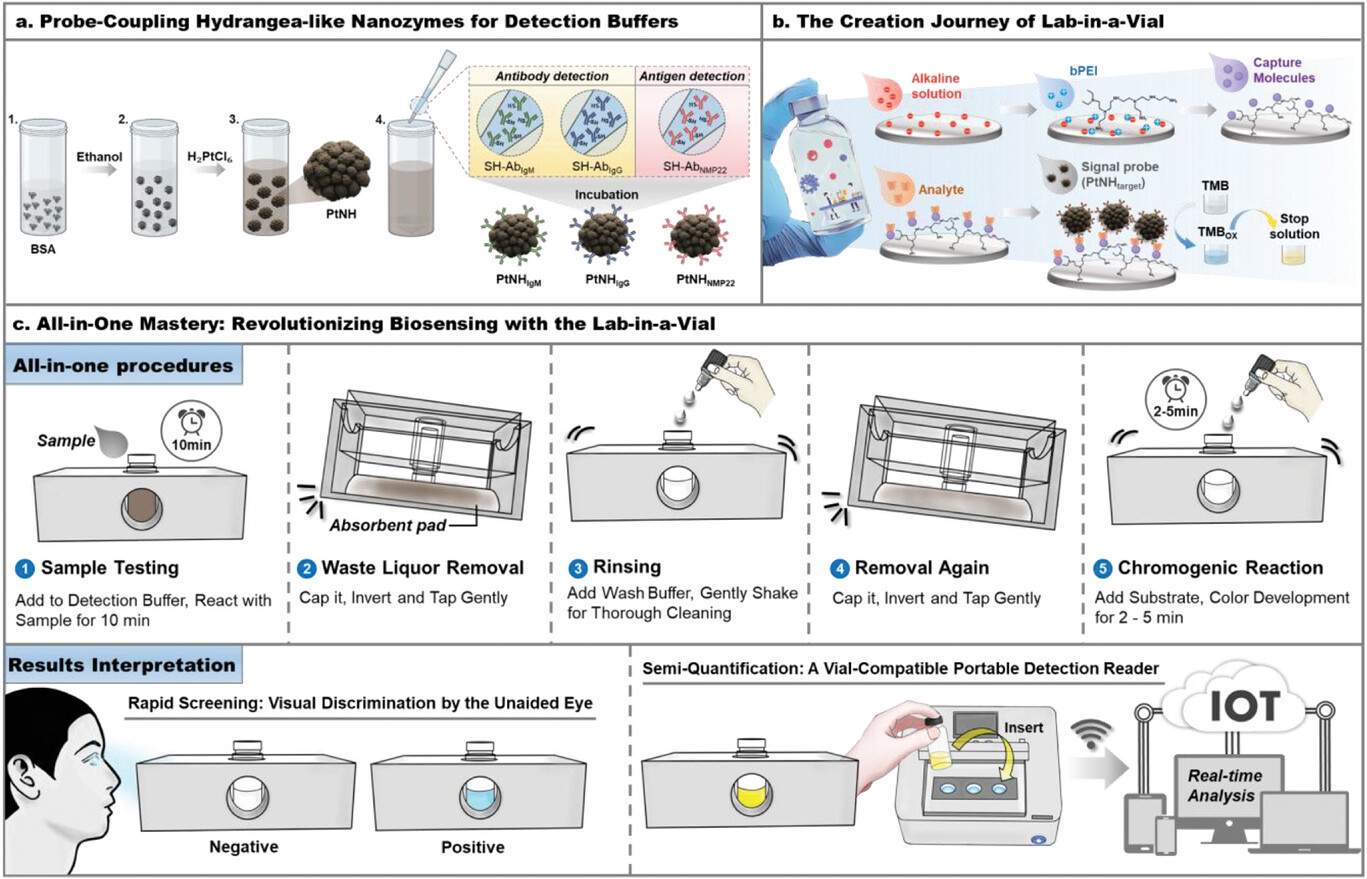 |
Conventional protein tests often require laboratory instruments, trained personnel, and lengthy procedures, while common rapid tests may not be sensitive enough to detect low levels of disease biomarkers. This study developed a Lab-in-a-Vial rapid diagnostic platform that performs the main functions of a laboratory test inside a small glass vial. Specific antibodies or antigens are attached to the vial, while hydrangea-like platinum nanozymes amplify the reaction and produce an easily visible color signal. With only a small bodily-fluid sample, the test can be completed in approximately 15 minutes. A portable optical reader can also quantify the result and transmit the data through the Internet. The platform was validated by detecting SARS-CoV-2 IgM and IgG antibodies in patient blood samples and the bladder-cancer biomarker NMP22 in urine. The results demonstrate the potential of this simple, sensitive, and adaptable platform for point-of-care disease screening and long-term health monitoring. |
 |
High blood uric acid levels are associated with hyperuricaemia, gout, kidney disorders, and other health problems. This study developed a mobile healthcare system that combines a disposable lateral-flow pad, Prussian blue nanozymes, a smartphone, and cloud-based data management. The specially designed paper pad separates red blood cells and reduces interference from the natural color of blood. Uric acid then produces a concentration-dependent color change, which is photographed by a smartphone and automatically analyzed by customized software. The system provided a linear measurement range of 1.5–8.5 mg/dL. Tests using real blood samples collected before and after meals produced results comparable to those of a commercial uric acid monitoring device. The paper sensors also remained stable after exposure to normal atmospheric conditions for 14 days. By avoiding centrifugation, natural enzymes, and conventional laboratory instruments, this platform offers a portable and user-friendly approach for daily uric acid monitoring and remote follow-up by healthcare professionals. |
 |
Protein biomarkers can be difficult to detect in highly viscous samples, such as saliva and sputum, or within the shallow layers of the skin. This study introduced the Lab-on-the-Needles concept and developed a portable microneedle-based sensing system called the MNP-based SenBox. The microneedles are coated with gold nanoparticles and specific antibodies or antigens, allowing them to capture target proteins directly from liquid samples or the epidermal layer of the skin. A stabilized HRP@ZIF-8 signal probe then amplifies the color reaction, and a portable color reader provides quantitative results. The system detected SARS-CoV-2-related antibodies and viral proteins in clinical saliva samples with detection limits at least 1,000 times lower than those of commercial saliva lateral-flow tests. It also measured the inflammatory cytokines TNF-α and IL-1β directly from the skin of rats within 30 minutes with minimal invasiveness. By integrating sampling and analysis on the same microneedle platform, this technology may support rapid diagnosis and longitudinal disease monitoring without repeated blood collection. |


.svg.png)