Dr. Yin-Tse Huang

Dr. Yin-Tse Huang
Position:Assistant Professor
Group:Biomedical technology
Research Interests:Medical Mycology, Genomics, Microbiome
E-mail: ythuangmyco@gs.ncku.edu.tw
Room:89A03
Room Tel:+886-6-2757575#58235
Laboratory Tel:+886-6-2757575#58244#113
Education
| School | Department | Country | Degree | Period |
| University of Florida | School of Forestry and Resources Conservation | USA | Ph.D. | 2015~2019 |
| National Chung Hsing University | Department of Plant Pathology | Taiwan | Master | 2009~2011 |
| Institute | Position | Period |
|---|---|---|
| Department of Biotechnology and Bioindustry Sciences, National Cheng-Kung University | Assistant Professor | 2026.02~now |
| Department of Biomedical Science and Environmental Biology, Kaohsiung Medical University | Assistant Professor | 2021.02~2026.01 |
| Center for Ecological Research, Kyoto University | Postdoctoral researcher | 2019.10~2021.01 |
| United States Forest Service, Northern Research Station | Visiting Scholar | 2016 |
| Institute of Microbiology, Czech Academy of Sciences | Visiting Scholar | 2016 |
| Name of Award | Year of Award |
|---|---|
| Country Representative, Young ISHAME (The International Society for Human & Animal Mycology) | 2025 |
| Recruitment and Retention of Distinguished Talent | 2021, 2022, 2024, 2025 |
| Human Frontier Science Program (HFSP) Postdoctoral Fellowship | 2019-2021 |
| Travel Funds, Mycological Society of America | 2018 |
| Travel Funds, Office of Research, University of Florida | 2018 |
| Travel Grant, SFRC, University of Florida | 2018 |
| Travel Grant, Institute of Food and Agricultural Sciences, University of Florida | 2017 |
| Oral Presentation Award, Taiwan Entomology Society Annual Meeting | 2017 |
| Margaret Walton Fellowship, University of Virginia | 2016 |
| Graduate Research Assistantship Award, University of Florida | 2015-2019 |
| Travel Grant, Mycological Society of Republic of China | 2013 |
| Travel Grant, Mycological Society of Republic of China | 2013 |
| Best Poster Award, 11th Asian Mycological Congress | 2013 |
| Oral Presentation Award, Mycological Society of Republic of China Annual Meeting | 2012 |
Research Interests
The MEGA Lab (Microbial Ecology, Genomics, and Applications) investigates the diversity, ecology, and evolution of fungi and microbial communities, and translates these findings into real-world applications in human health and agriculture. Our lab is equipped with modern facilities for molecular biology, microbiology, and bioinformatics, including Oxford Nanopore long-read sequencing, high-throughput amplicon and metagenomic sequencing pipelines, and computational resources for multi-omics data analysis. We maintain extensive fungal culture collections comprising clinical and environmental isolates of medically important species, insect-associated symbiotic fungi, and entomopathogenic strains sourced from diverse ecological niches across Taiwan and internationally.
Our current research spans three major areas: (1) ecology and antifungal resistance of opportunistic fungal pathogens under a One Health framework, (2) development of entomopathogenic fungi for sustainable biocontrol, and (3) urbanization-driven changes in soil microbial diversity, community structure, and functional potential.
 |
Ecology and antifungal resistance of opportunistic fungal pathogens under a One Health framework: Invasive fungal infections cause significant global mortality, yet therapeutic options remain limited to three mechanistic drug classes. Our research uses intrinsically multidrug-resistant Scedosporium and Lomentospora species — WHO priority pathogens — as model systems to study constitutive resistance mechanisms and identify novel therapeutic targets. Through international collaborations, we are building a comprehensive Asia-Pacific strain biobank and applying 4D multi-omics integration (genomics, transcriptomics, proteomics, metabolomics) to map the molecular networks underlying pan-resistance. Candidate targets are functionally validated using a CRISPR-Cpf1 genome editing platform developed specifically for these species, and translated into therapeutic strategies through nanomedicine delivery systems, drug repurposing screens, and in vivo efficacy testing. Because this pipeline targets organisms with the highest baseline resistance, the resulting discoveries are directly transferable to other clinically important pathogens such as Candida auris and azole-resistant Aspergillus. |
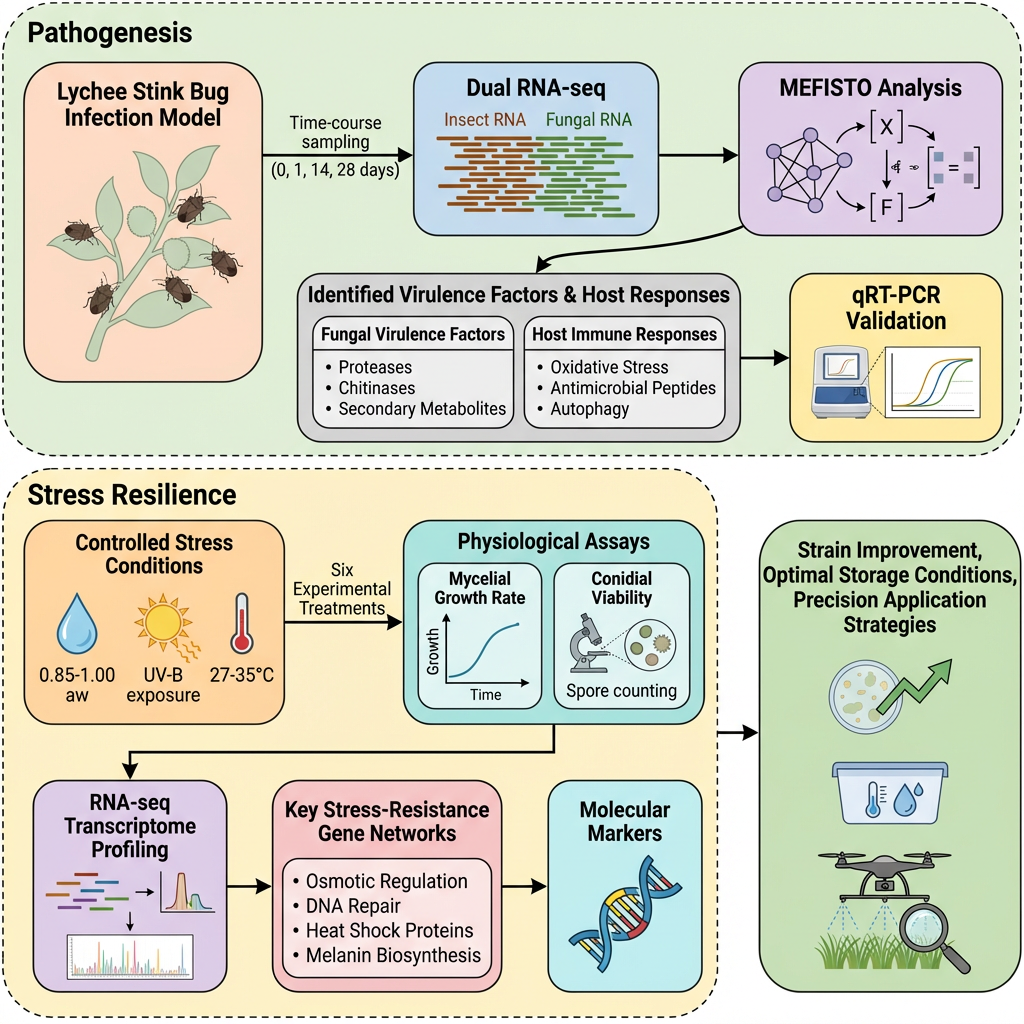 |
Development of entomopathogenic fungi for sustainable biocontrol: The lychee stink bug (Tessaratoma papillosa) causes huge yield losses in lychee and longan orchards across Taiwan and Southeast Asia, yet sustainable alternatives to chemical pesticides remain limited. Our research uses Purpureocillium takamizusanense TCTeb01 — a locally isolated entomopathogenic fungus with demonstrated field efficacy and confirmed biosafety — as a model system to develop molecular-level understanding of fungal biocontrol. Through dual RNA-seq and MEFISTO temporal factor analysis, we are decoding the dynamic molecular interplay between fungal virulence strategies and insect immune defenses across the infection process, with candidate genes functionally validated via qRT-PCR. In parallel, we systematically assess fungal resilience under field-relevant environmental pressures — reduced water activity, UV-B radiation, and temperature extremes — integrating physiological assays with transcriptome profiling to uncover stress-resistance gene networks and establish molecular markers for strain improvement and precision application. Because this pipeline addresses both pathogenesis and environmental durability, the resulting framework is directly transferable to other entomopathogenic systems targeting agricultural pests beyond the lychee stink bug. |
 |
Urbanization-driven changes in soil microbial diversity, community structure, and functional potential: Urbanization alters soil properties and reshapes belowground microbial communities, yet the extent and mechanisms of these changes remain poorly characterized in subtropical regions. This project investigates how urbanization gradients affect soil microbial diversity, community assembly, and functional potential across Taiwan. We collect soils from sites spanning four land-use categories—forestry, agricultural, recreational, and public greenspaces—stratified by the Human Footprint Index. Soil physicochemical properties (pH, organic matter, total carbon and nitrogen, available phosphorus, exchangeable cations) are measured alongside bacterial and fungal community profiling via 16S rRNA and ITS amplicon sequencing using Oxford Nanopore metabarcoding pipelines. Integrated analyses of alpha and beta diversity (βNTI), environmental driver correlations, and functional dissimilarity metrics are applied to evaluate whether urbanization drives taxonomic and functional homogenization of soil microbiomes, and whether bacteria and fungi respond synchronously or asynchronously to land-use change. This work aims to provide a regional-scale framework for understanding urbanization impacts on soil biodiversity and ecosystem function in a rapidly developing subtropical island. |


.svg.png)