Dr. Shih-Ming Lin

Dr. Shih-Ming Lin
Position:Associate Professor
Group:Agriculture & Aquaculture technology group
Research Interests:Structural Biology, Enzyme kinetics and Biophysical Chemistry
E-mail:smlin@mail.ncku.edu.tw
Room:89703
Room Tel:+886-6-2757575#58210
Laboratory Tel:+886-6-2757575#58214#714
Education
|
School |
Department |
Country |
Degree |
Period |
|
National Tsing Hua University |
Institute of Bioinformatics and Structural Biology information technology |
TW |
Ph.D. |
|
|
Institute |
Position |
Period |
|---|---|---|
|
Department of Biotechnology and Bioindustry Sciences, National Cheng-Kung University |
Associate Professor |
2024~now |
|
Department of Biotechnology and Bioindustry Sciences, National Cheng-Kung University |
Assistant Professor |
2016~2024 |
Research Interests
Plants use a variety of plant hormones and phytochemicals to transmit signals and produce appropriate responses in response to various environmental stimuli. Therefore, these plant hormones and phytochemicals need to be transported and delivered precisely, and as a result, plants have evolved a series of transmembrane transport proteins that can accurately recognize the molecular structures of diverse plant hormones and perform transmembrane transport in a highly specific and sensitive manner. Our team is trying to decipher the biochemical characteristics and molecular structures of these transport proteins, in order to clarify how these sequence-similar transport proteins recognize and transport their corresponding small molecule substrates, and thereby effectively regulate the overall hormone distribution in plants. In the future, we hope to apply this knowledge to develop strategies related to plant growth regulation, in order to increase crop yields and reduce the use of chemical fertilizers, and move towards the vision of sustainable agriculture.
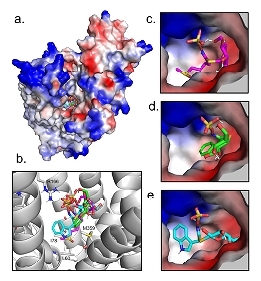 |
Glucosinolates (GLSs) are secondary metabolites that play a crucial role in plant defense against herbivores. In Arabidopsis thaliana, GLSs are transported via a proton gradient-driven process by Glucosinolate Transporter 1 (AtGTR1), which also transports phytohormones such as jasmonic acid-isoleucine (JA-Ile) and gibberellin (GA). However, little is known about the mechanisms underlying the broad substrate specificity of AtGTR1. To investigate the substrate preferences of AtGTR1, a yeast uptake assay was conducted, which showed that the transport rate of GLSs is negatively correlated with their hydrophobicity. AtGTR1 also showed a higher affinity for GLSs with higher hydrophobicity, suggesting a hydrophobic substrate binding pocket. Competition assays revealed that JA, salicylic acid (SA), and indole-3-acetic acid (IAA) can compete with GLS for transport in yeast, suggesting a potential interaction between AtGTR1 and these phytohormones. Mutagenesis experiments confirmed that the conserved EXXEK motif and Arg166 are essential for the GLS transport function of AtGTR1. The purified AtGTR1 adopts a homodimeric conformation, which is possibly regulated by phosphorylation on Thr105. The phosphomimetic mutation, T105D, reduced protein expression and completely abrogated the GLS transport function of AtGTR1, indicating the essential role of phosphorylation on AtGTR1. These findings enhance our understanding of how the distribution of defense GLSs is regulated in plants and could be applied to improve crop quality in agriculture. |
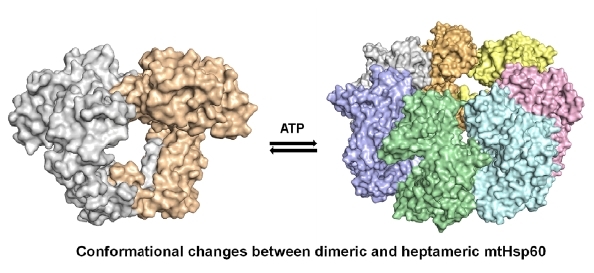 |
The proper folding of proteins in the mitochondria is crucial for maintaining cellular function, and Mitochondrial Hsp60 (mtHsp60) plays a significant role in this process. mtHsp60 is a tetradecamer, composed of two heptameric rings, but it tends to dissociate in vitro. However, the exact structure of dissociated mtHsp60 and the mechanism behind its dissociation remain unclear. Our research focuses on Epinephelus coioides mtHsp60 (EcHsp60), which can form a dimeric structure with inactive ATPase activity. The crystal structure of this dimer shows symmetrical subunit interactions and a rearranged equatorial domain. The α4 helix of each subunit extends and interacts with its adjacent subunit, leading to the disruption of the ATP-binding pocket. Additionally, the apical domain of the dimeric complex contains a highly conserved RLK motif that contributes to stabilizing the dimeric complex. These findings provide new insights into the conformational transitions and functional regulation of mtHsp60. The dimeric structure of EcHsp60 provides novel insight on the dissociation mechanism of mtHsp60 and offers a potential explanation for its instability in vitro. This study provides a foundation for future investigations into the functional regulation of mtHsp60 and its role in protein folding in the mitochondria. |


.svg.png)