Dr. Fu-I Lu

Dr. Fu-I Lu
Position:Associate Professor
Group:Agriculture & Aquaculture technology group
Research Interests:Developmental biology and physiology in fish
E-mail:fuilu@mail.ncku.edu.tw
Room:89805
Room Tel:+886-6-2757575#58218
Laboratory Tel:+886-6-2757575#58224#813
|
School |
Department |
Country |
Degree |
Period |
|---|---|---|---|---|
|
University of Strasbourg |
Institute of Genetics and Molecular and Cellular Biology |
France |
Ph.D. |
|
|
Institute |
Position |
Period |
|---|---|---|
|
Department of Biotechnology and Bioindustry Sciences, National Cheng-Kung University |
Associate Professor |
2019~now |
|
Department of Biotechnology and Bioindustry Sciences, National Cheng-Kung University |
Assistant Professor |
2014~2019 |
Research Interests
Fish need to adjust their physiological conditions to cope with environmental challenges such as temperature and osmolarity changes in order to survive in water. By comparing the physiology of different fish species, such as zebrafish, goldfish, tilapia, and grouper, that live in diverse aquatic environments, we aim to understand how they regulate their physiological functions to adapt to dynamic situations. In addition to studying fish physiology, our laboratory focuses on developmental biology using zebrafish as a model organism. The transparency of zebrafish embryos at early stages and their ease of manipulation make them ideal for studying cellular processes such as cell differentiation and migration during early vertebrate embryonic development.
One of our research interests is to investigate the mechanisms that determine body asymmetries, including the anterior-posterior, dorsal-ventral axes, and left-right asymmetry in vertebrates. Another research interest is to clarify the mechanisms involved in regulating cell movements during the gastrulation period. We aim to identify the genes and signaling pathways that control these body asymmetries and cell movements during early embryonic development.
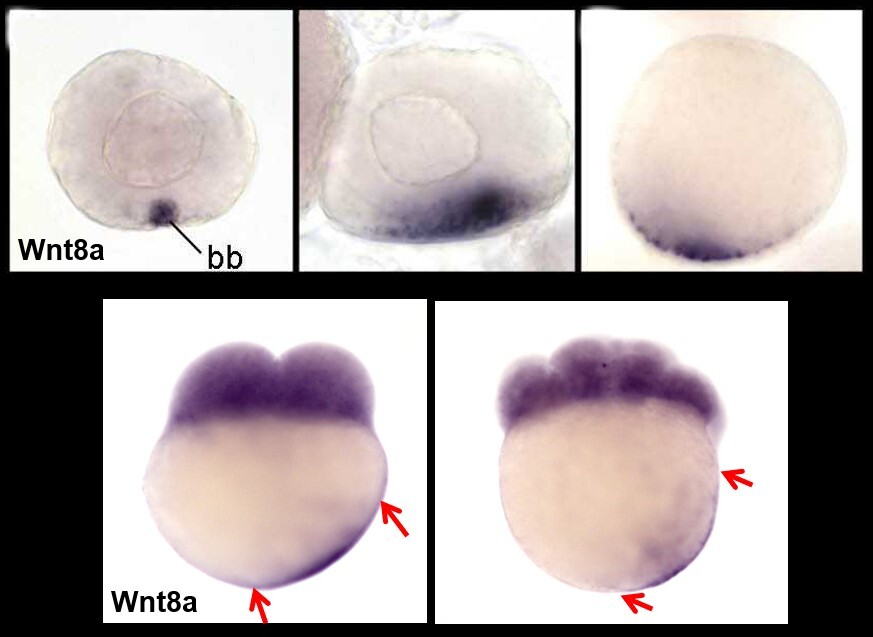 |
The animal-vegetal axis in vertebrates is established during oogenesis, resulting in a radially symmetric egg at ovulation. In anamniotes, fertilization triggers a microtubule-dependent movement of the maternal dorsal determinants, initiating embryonic axis formation. In this study, we identified the vegetal maternal dorsal determinant in fish as Wnt8a mRNA. The migration of Wnt8a mRNA established a dorsal-to-ventral gradient of Wnt signaling that spans the entire embryo. This gradient is limited by two Wnt inhibitors, Sfrp1a and Frzb, which restrict the activation of the beta-catenin pathway to the dorsal marginal blastomeres. Our findings reveal the molecular mechanisms that regulate embryonic axis formation in fish and provide insight into the evolution of axis formation in vertebrates. |
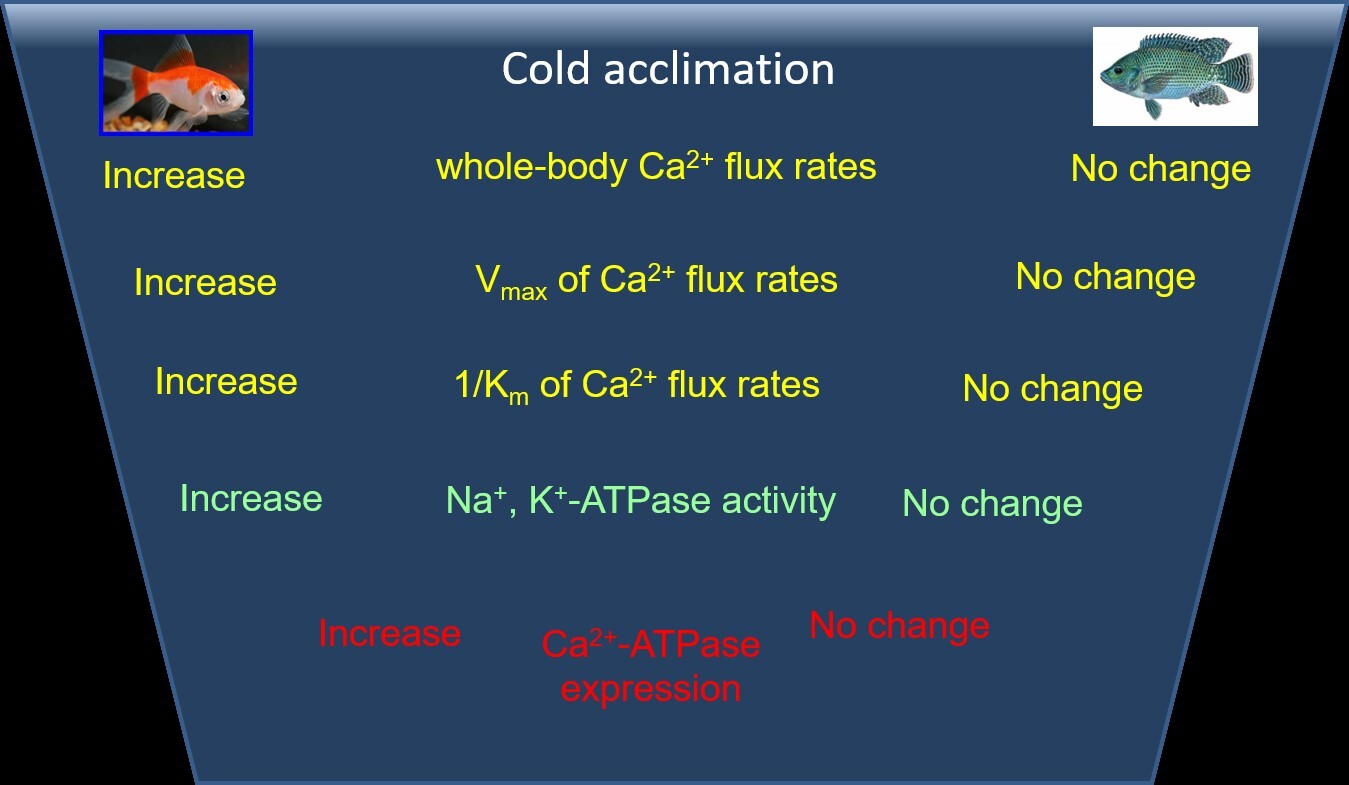 |
Fibrosing Teleost species adjust their body temperature according to the aquatic environment they live in. When water temperature decreases, biochemical reactions and physiological processes, including ion absorption, can be affected. Previous studies have mainly examined the impact of low temperature on plasma ion concentrations or membrane transporters in fishes. In this study, we compared how stenothermic tilapia and eurythermic goldfish acclimate to cold temperatures. Our results showed that long-term cold exposure led to a greater decrease in whole-body calcium content in tilapia than in goldfish. Furthermore, goldfish exhibited better calcium absorption and higher expression of plasma membrane Ca2+-ATPase, as well as higher Na+/K+-ATPase activity, which provides the major driving force for ion absorption. These differences may be due to goldfish's more effective regulation of Ca2+ influx kinetics and better maintenance of whole-body calcium content compared to tilapia. |
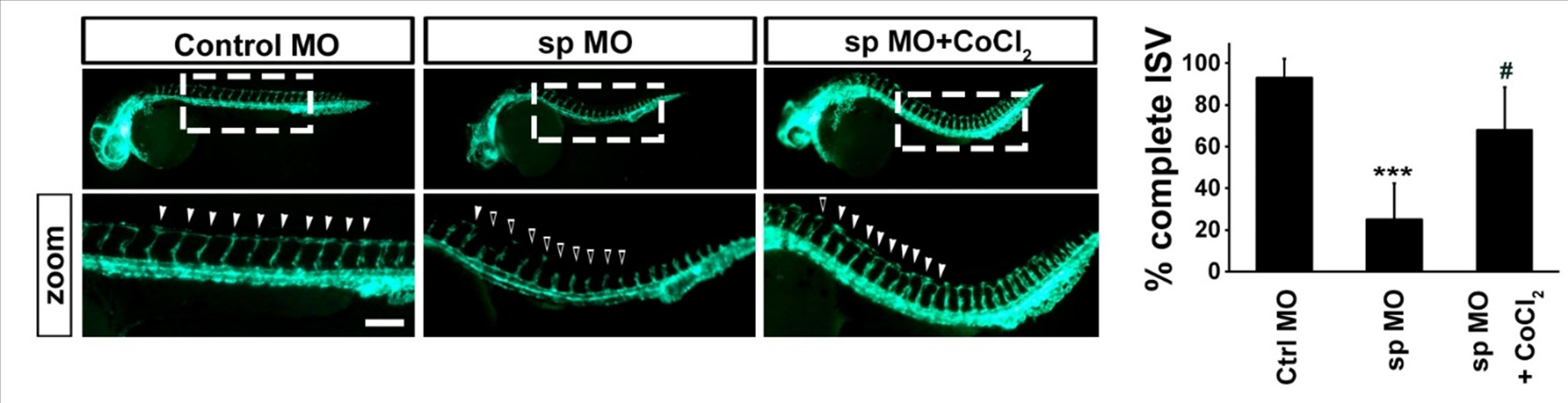 |
EGF is known to promote the formation of new blood vessels by inducing endothelial cell (EC) proliferation and migration. Brefeldin A (BFA)-inhibited guanine nucleotide-exchange proteins (BIGs) 1 and 2 accelerate the activation of ADP-ribosylation factor (Arf) 1, which regulates vesicular transport between the Golgi and plasma membrane by replacing bound GDP with GTP. While previous studies have suggested that treatment with BFA can inhibit VEGF secretion by interfering with Arf1 activation, the exact role of BIG1 and BIG2 in VEGF trafficking, expression, EC migration and proliferation, and vascular development remains unclear. Our study found that angioblast migration and intersegmental vessel sprouting were impaired when the BIG2 homolog, Arf guanine nucleotide exchange factor (arfgef) 2, was knocked down in zebrafish with the endothelial expression of green fluorescent protein (GFP). Moreover, the depletion of arfgef2 by CRISPR/Cas9 also resulted in vascular development defects in zebrafish embryos. These findings suggest that BIG1 and BIG2 play a crucial role in endothelial cell angiogenesis. (Chen et al., 2020; Han et al., 2018; Li et al., 2022; Lu et al., 2019; Rothschild et al., 2020) |


.svg.png)