Dr. Yu-Chih Lo

Dr. Yu-Chih Lo
Position:Professor
Group:Biomedical technology group
Research Interests:Structural Immunology, Signal Transduction, Protein Drug Design
E-mail:gracelo@ncku.edu.tw
Room:89A04
Room Tel:+886-6-2757575#58228
Laboratory Tel:+886-6-2757575#58244#114
|
School |
Department |
Country |
Degree |
Period |
|---|---|---|---|---|
|
National Defense Medical Center |
Institute of Life Sciences |
TW |
Ph.D. |
|
|
Institute |
Position |
Period |
|---|---|---|
|
Department of Biotechnology and Bioindustry Sciences, National Cheng-Kung University |
Professor |
2025~ |
|
Department of Biotechnology and Bioindustry Sciences, National Cheng-Kung University |
Associate Professor |
2017~2025 |
|
Department of Biotechnology and Bioindustry Sciences, National Cheng-Kung University |
Assistant Professor |
2011~2017 |
|
Cornell University, USA |
Postdoctoral Fellow |
2005~2011 |
|
Academia Sinica |
Postdoctoral Fellow |
2004~2005 |
|
Name of Award |
Year of Award |
|---|---|
|
NCKU 112 Academic Year Teaching Excellence Award |
2024 |
|
American Heart Association Postdoctoral Fellow Award |
2009 |
|
Cancer Research Institute Postdoctoral Fellow Award |
2005 |
Research Interests
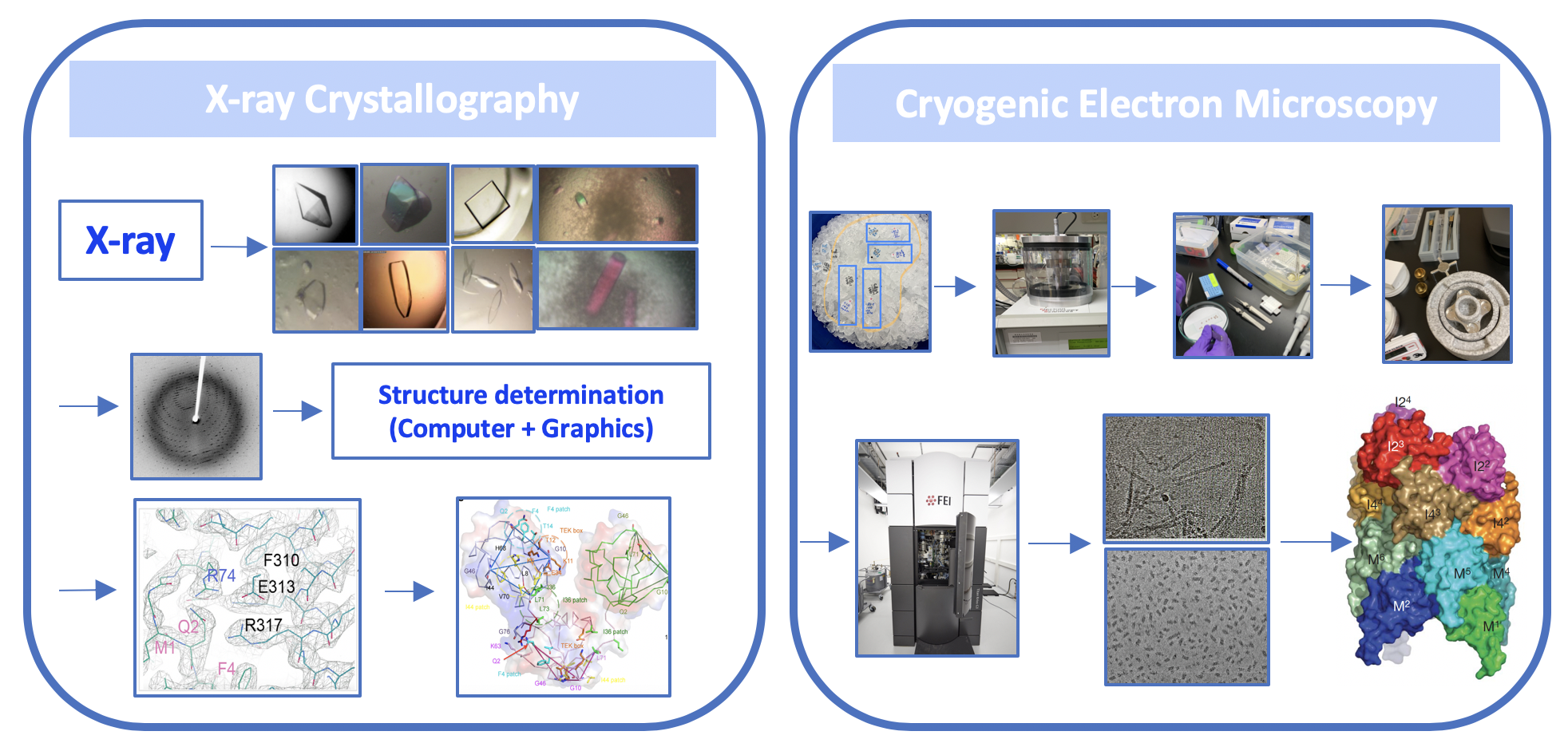
My lab specializes in structural biology. Our long-term research goal is to understand the molecular recognition mechanisms of the multiprotein complexes involved in cell survival signaling pathways as well as the cell death signaling pathways induced by extrinsic death receptors (DRs)-mediated and intrinsic Apoptosome-mediated cell death. We are also very interested in the pathogenic mechanism of non-structural proteins of human viruses. We conduct in vitro experiments and combine them with clinical samples collected from patients to carry out in vivo experiments to understand the molecular mechanisms of important viral proteins that cause diseases. To achieve this, we utilize X-ray crystallography and CryoEM techniques in conjunction with biochemical assays and cellular biology approaches. The results of our research will help to elucidate the recognition mechanisms of signaling protein complexes that control innate im-munity, inflammation, and cell death, and could lead to the novel drug design and therapies for treating human diseases caused by dysregulated molecules.
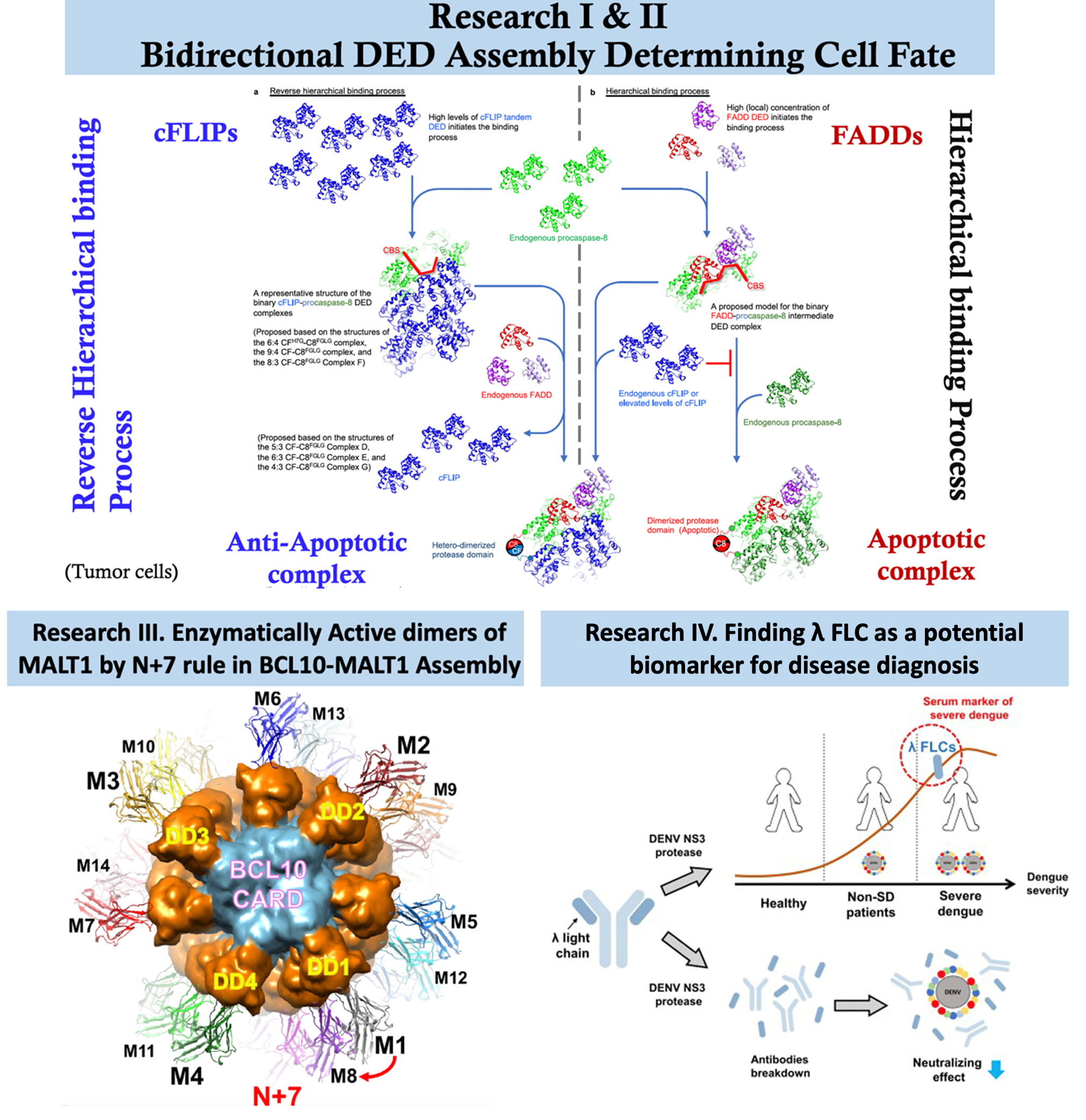 |
Our research I. Explore Caspase8-cFLIP Complex Assembling in Tumor Cell Survival The findings provide insights into how tumor cells sustain survival and suggest strategies for designing targeted anti-cancer therapies that exploit these molecular features. II. Unravel Assembling of the FADD-procaspase-8-cFLIP Complex in Apoptosis This work advances the understanding of apoptosis and provides a structural basis for therapeutic interventions in diseases involving these pathways. III. Elucidate Enzymatically Active dimers of MALT1 by N+7 rule in BCL10-MALT1 Assembly The structural and functional insights pave the way for novel therapeutic strategies in immune and lymphoid malignancies. IV. A Potential Biomarker Discovery in Dengue Fever The findings establish λ FLC as a potential biomarker for disease diagnosis and severity assessment while shedding light on the viral immune evasion mechanisms. V. Met1-PolyUbs as a Multiple-molecule Binding Platform Our work provides a structural-functional glimpse of Met1-polyUb as a multiple-molecule binding platform to exert its intrinsic structural plasticity in mediating NF-κB signaling. We also identified ABIN1’s UBAN domain as a critical regulator that binds M1-polyubiquitin (Met1-polyUb), competing with other signaling molecules such as NEMO and RIP1. Structural analyses revealed that Met1-polyUb chains exhibit flexibility, facilitating the recruitment of multiple partner molecules to amplify signal transduction. These discoveries enhance our understanding of immune regulation and signal amplification, with implications for treating inflammation and autoimmune diseases.
|
Selected Publications
KR Chen, HY Wang, YC Kuo, YC Lo, PL Kuo (2025) A novel SEPT12 mutation, T96I, is associated with sperm head and annulus defects. Front. in Cell Dev. Biol., 12:1498013.
CY Yang, YC Tseng, YF Tu, BJ Kuo, LC Hsu, CI Lien, YS Lin, YT Wang, YC Lu, TW Su, YC Lo*, and SC Lin* (2024). Reverse hierarchical DED assembly in the cFLIP-procaspase-8 and cFLIP-procaspase-8-FADD complexes. Nature Communications, 15:8974.
CY Yang, CI Lien, YC Tseng, YF Tu, A. W. Kulczyk, YC Lu, YT Wang, TW Su, LC Hsu*, YC Lo*, and Lin SC* (2024). Deciphering DED assembly mechanisms in FADD-procaspase-8-cFLIP complexes regulating apoptosis. Nature Communications, 15:3791.
BJ Kuo, SC Lin, YF Tu, PH Huang, YC Lo* (2024). Study of individual domains contributing to MALT1 dimerization in BCL10-independent and dependent assembly. Biochemical and Biophysical Research Communications, 717, 150029.
SH Wang, BJ Kuo, TC Ho, SW Wan, KL Yen, PH Huang, Oscar GC Perng, PL Chen, YW Chieng*, and YC Lo* (2023). Lambda-free light chain: A serum marker of dengue disease via NS3 protease-mediated antibody cleavage. Virulence, 14(1): 2279355.
JY Hong, SC Lin, BJ Kuo, YC Lo* (2021). Structural and biochemical basis for higher-order assembly between A20-binding inhibitor of NF-kB 1 (ABIN1) and M1-linked ubiquitins. J. Mol. Biol., 433; 167116
SM Lin, SC Lin, JY Hong, TW Su, BJ Kuo, WH Chang, YF Tu, YC Lo* (2017). Structural insights into linear tri-ubiquitin recognition by A20-bind-ing inhibitor of NF-κB (ABIN)-2. Structure, 2017; 25; 66-78.
TW Su, CY Yang, WP Kao, BJ Kuo, SM Lin, JY Lin, YC Lo*, SC Lin* (2017). Structural insights into DD-fold assembly and caspase-9 acti-vation by the Apaf-1 Apoptosome. Structure, 25; 407-420.
YC Lo and GC Perng* (2016). Novel concept on antiviral strategies to dengue. Current Opinion in Virology, 18; 97–108.
YC Lo*, SC Lin, CY Yang, JY Tung (2015). Tandem DEDs and CARDs suggest novel mechanisms of signaling complex assembly. Apoptosis, 20; 124-135.


.svg.png)