Dr. Ding-Yen Lin

Dr. Ding-Yen Lin
Position:Associate Professor
Group:Biomedical technology group
Research Interests:Protein-protein interactions, Post translational modifications (PTMs), Cancer biology
E-mail:lindy@mail.ncku.edu.tw
Room:89A05
Room Tel:+886-6-2757575#58229
Laboratory Tel:+886-6-2757575#58244#112
Education
|
School |
Department |
Country |
Degree |
Period |
|---|---|---|---|---|
|
National Defense Medical Center |
Institute of Life Sciences |
TW |
Ph.D. |
|
|
Institute |
Position |
Period |
|---|---|---|
|
Department of Biotechnology and Bioindustry Sciences, National Cheng-Kung University |
Associate Professor |
2015~now |
|
Department of Biotechnology and Bioindustry Sciences, National Cheng-Kung University |
Assistant Professor |
2008~2015 |
|
Department of Biotechnology and Bioindustry Sciences, National Cheng-Kung University |
Project Assistant Professor |
2006~2008 |
|
National Health Research Institutes |
Postdoctoral Fellow |
2002~2006 |
Research Interests
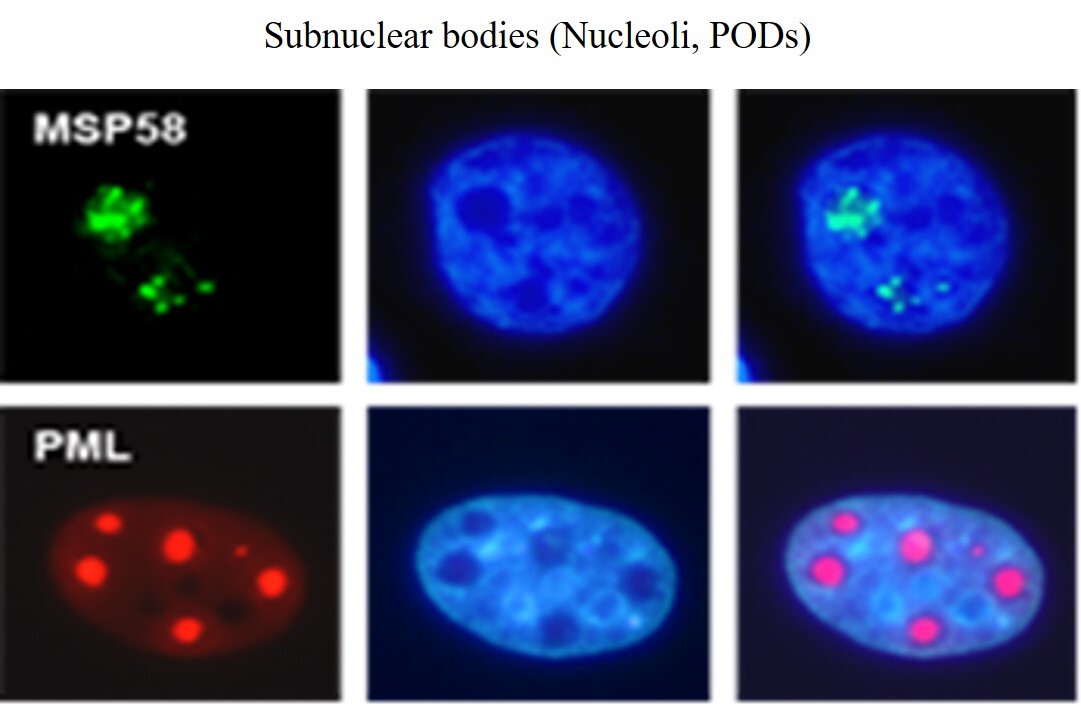
The research in my laboratory is to study the protein-protein interactions and signal transduction pathways involved in human disease such as cancer and aging. We are particularly interested in the role of nucleolar protein MSP58 induced cell transformation and senescence. Several novel MSP58 associated proteins were recently identified by yeast two-hybrid screen in my laboratory. They are including some members of nucleosome remodeling complexes, centrosomal proteins and telomerase/telomere interacting proteins. A second area of research addresses on how cells maintain and regulate the proper balance of protein modification and/or degradation localizes in subnuclear compartments such as PML oncogenic domains (PODs). PODs recruit many functionally diverse proteins and may function as a platform for protein modification and/or degradation. We have identified several novel PML associated proteins that appear to have an impact on its stability and activity. Determining the mechanisms by which these proteins affect PML/PODs will provide considerable insight into PML functions and cancer development.
 |
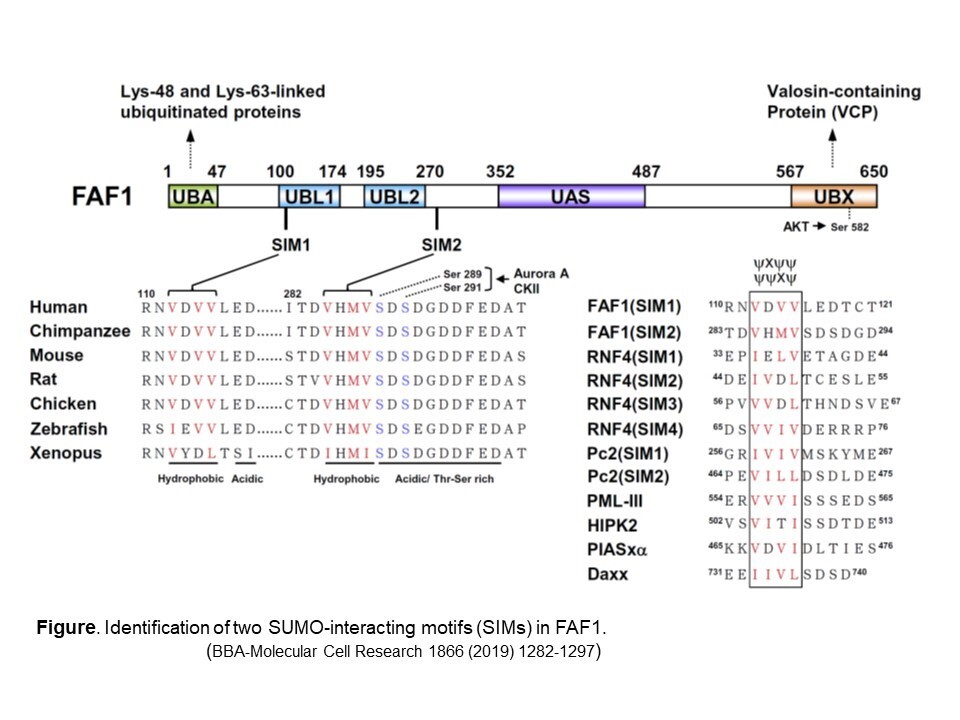
Identification of two SUMO-interacting motifs in Fas-associated factor 1 (FAF1) Small ubiquitin-like modifier (SUMO) conjugation (Sumoylation) is known to affect many characteristics of proteins, including their protein-protein interactions, transcriptional regulation functions, subcellular localization and stability. Fas-associated factor 1 (FAF1) is a multidomain protein that interacts with diverse partners to affect numerous cellular processes. Notably, FAF1 participates the proteasomal degradation of ubiquitinated proteins, as it is thought to act as a scaffold protein for multiple ubiquitin-related domains, including ubiquitin-associated (UBA), ubiquitin-like 1 and 2 (UBL1, UBL2), and ubiquitin-regulatory X (UBX) domains. Previously, we discovered two SUMO-interacting motifs (SIMs) within FAF1 that are crucial for binding for sumoylated mineralocorticoid receptor (MR). Additionally, we showed that FAF1 can promote the degradation of MR, thereby inhibiting the its transactivation of target genes. Our work provides novel mechanistic insights into the role of FAF1/SIMs in SUMO-dependent transcriptional modulation and proteolysis. Further work will be required to clarify how the SIMs and ubiquitin-related domains of FAF1 differentially contribute to its regulation of diverse biological processes. |
 |


.svg.png)