Dr. Liang-Yi Hung

Dr. Liang-Yi Hung
Position:Distinguished Professor
Group:Biomedical technology group
Research Interests:cancer research, inflammatory signal transduction, and cell cycle gene regulation
E-mail:lyhung@mail.ncku.edu.tw
Room:89903
Room Tel:+886-6-2757575#58222
Laboratory Tel:+886-6-2757575#58234#914
|
School |
Department |
Country |
Degree |
Period |
|---|---|---|---|---|
|
National Defense Medical Center |
Institute of Life Sciences |
TW |
Ph.D. |
|
|
Institution |
Position |
Period |
|---|---|---|
|
Department of Biotechnology and Bioindustry Sciences, NCKU |
Distinguished Professor |
2026.02~present |
|
University Center for Bioscience and Biotechnology, NCKU |
Director |
2024.12~present |
|
Office of Student Affairs, NCKU |
Vice President |
2023.02~present |
|
University Center for Bioscience and Biotechnology, NCKU |
Deputy Director |
2023.02~2024 |
|
Department of Biotechnology and Bioindustry Sciences, NCKU |
Chairman |
2022.08~2023.01 |
|
Department of Biotechnology and Bioindustry Sciences, NCKU |
Professor |
2016~2026.01 |
|
Department of Biotechnology and Bioindustry Sciences, NCKU |
Associate Professor |
2012~2016 |
|
Department of Biotechnology and Bioindustry Sciences, NCKU |
Assistant Professor, |
2009~2012 |
|
Department of Biotechnology and Bioindustry Sciences, NCKU |
Project Assistant Professor |
2005~2009 |
|
Academia Sinica |
Postdoctoral Fellow |
2000~2005 |
Research Interests
We study the regulatory mechanisms of overexpressed Aurora A and the functional roles of overexpressed CPAP in cancers. Aurora-A is abnormally overexpressed in many cancers. By studying the transcriptional and translational regulation of overexpressed Aurora A, we have found a novel strategy for early diagnosis and cancer target therapy. In addition, we also investigated the association of tumor-intrinsic Aurora A with tumor immunosuppression. In addition to Aurora-A, the tumor microenvironment has a great influence on the growth and metastasis of cancers via promoting inflammatory pathways. Our studies indicated that CPAP can transcriptionally activate NF-κB and STAT3, both of which are important inflammatory factors affecting the development of cancers. We hope our investigation can find novel and effective strategies for the treatment of cancers by studying the role of CPAP protein in cancer development.
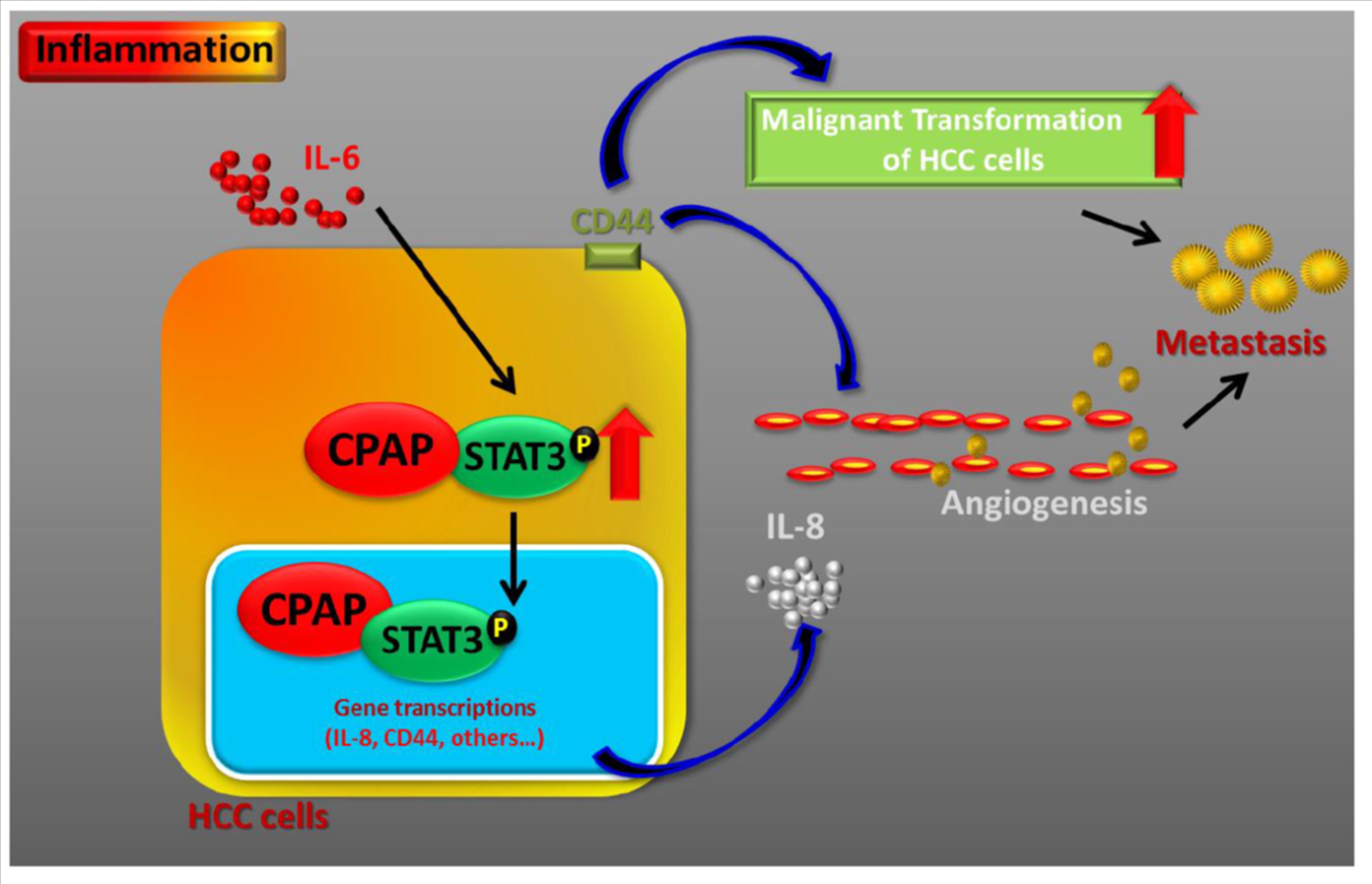 |
Our study demonstrated that CPAP overexpression promotes cancer metastasis and angiogenesis through enhancing IL-6/STAT3 activity, and increases sorafenib, an anti-angiogenesis drug, resistance in HCC. Using ex vivo cell models and in vivo animal models, we demonstrated that CPAP overexpression not only increases cell migration and angiogenesis abilities but also promotes cancer metastasis by enhancing IL-6/STAT3 activity through direct interaction with STAT3. The expression of STAT3 downstream target genes involved in metastasis is increased in CPAP-overexpressing HCC cells. The interacting domain between CPAP and STAT3 was clarified in this study. Blocking the interaction between CPAP and STAT3 diminished the CPAP-enhanced cell migration, angiogenesis, and metastasis in HCC. In conclusion, our study details the important role of CPAP in HCC malignancies and describes a novel interaction between CPAP and STAT3 and their downstream effect in promoting HCC tumor angiogenesis, metastasis, and sorafenib resistance. Results from this study can provide potential therapeutic strategies for treating metastatic HCC. |
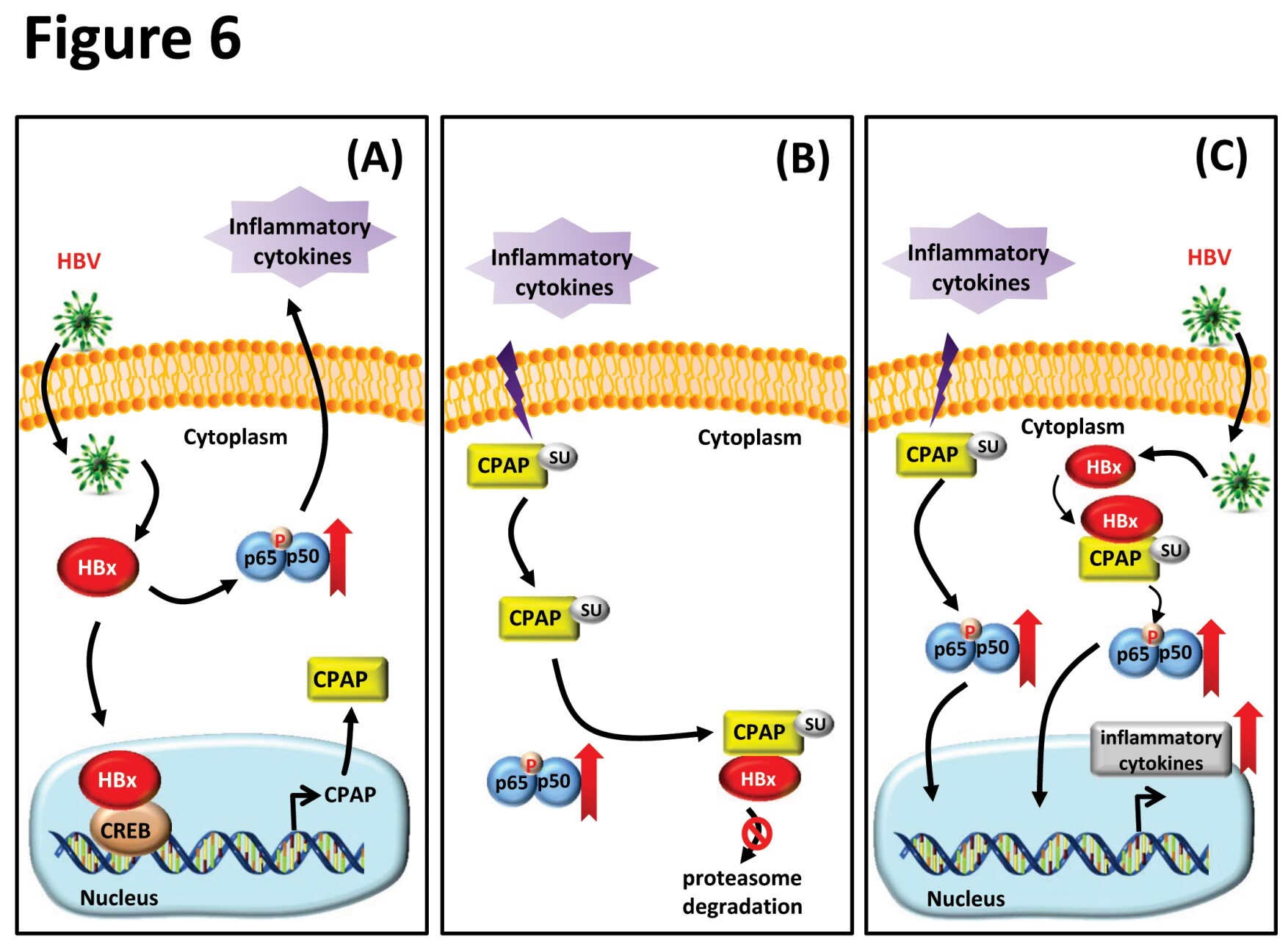 |
Our previous report indicates that TNF-α can induce SUMO-1 modification of CPAP which is required for IKK-mediated NF-κB activation and promotes the growth of HCC cells (Journal of Hepatology 2013, 58(6): 1157-1164). In that report (2013 JH), we presented how CPAP can enhance the transcriptional activity of NF-κB by increasing the phosphorylation of NF-κB/p65 and IκBα through mediating the recruitment of IKKb to the inactivated NF-κB complex. Most interestingly, SUMO-1 modification of CPAP on residues K921 and K975 plays an important role in this pathway. In addition, SUMOylated CPAP collaborates with HBx to increase the NF-κB activity in HBV-associated HCC. In the current study, our results indicated that HBx can transcriptionally up-regulate the expression of CPAP, and overexpressed CPAP can maintain the protein stability of HBx in an NF-κB-dependent manner. The expression level of CPAP and HBx is positively correlated only in the non-tumorous tissues of HCC but not the tumorous tissues. Most importantly, co-expression of HBx and CPAP enhances the abilities of proliferation, migration, and metastasis in both HCC cells and xenograft animal models compared with CPAP- or HBx-expression alone. By transgenic animal model, hepatocyte-specific co-expressed CPAP/HBx double transgenic mouse presents an early incidence of HCC compared with CPAP or HBX single transgenic mouse. Knocked-down expression of CPAP or overexpressed CPAP SUMO-deficiency mutant can block the effects that induced by HBx. |
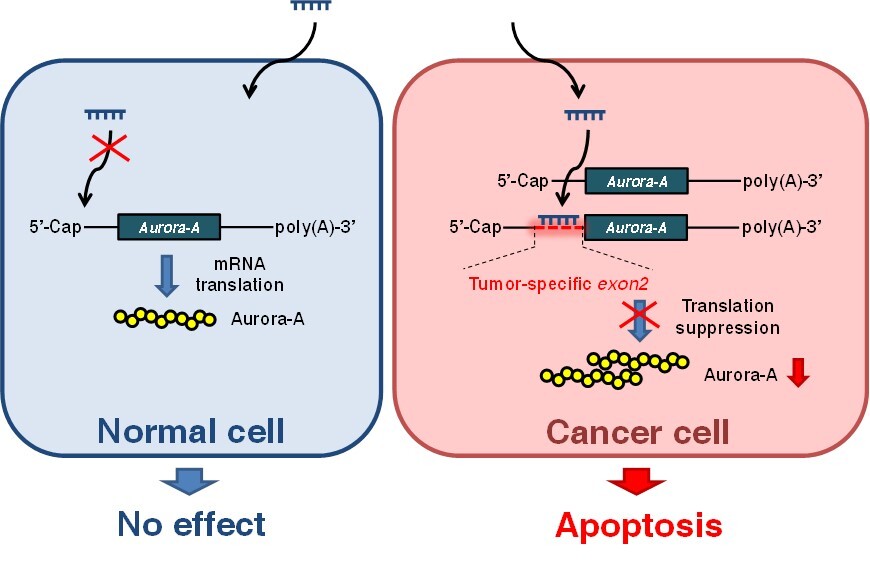 |
Aurora-A inhibitors have been in development for cancer therapy; however, the insufficient specificity and severe side effects of Aurora-A inhibitors raise concern for their use for cancer treatment. Our studies have found that Aurora-A mRNA exon 2, which is located in the 5’-untranslated region (5’-UTR), is predominantly expressed in cancer cells but not the normal cells. This cancer-specific expressed Aurora-A exon 2 makes it a perfect target for developing a novel siRNA-based drug for cancer therapy. This study details a novel Aurora-A exon 2 specific siRNA—siRNA-2—in cancer treatment. Our results demonstrate the specificity, safety, and efficiency of siRNA-2 in anticancer treatment. siRNA-2 effectively and specifically inhibits the translation of exon 2-containing Aurora-A mRNA in cancer cells, but does not affect other Aurora kinases, without affecting normal cells; moreover, locked nucleic acid (LNA) modification of siRNA-2 largely increases its efficacy in inhibiting Aurora-A mRNA translation and anticancer abilities. Both cell models and animal models indicate that LNA-siRNA-2 can decrease cell proliferation and induce apoptosis in cancer cells with no severe side effects. Our results suggest this selective LNA-siRNA-2 has therapeutic potential in Aurora-A-overexpressing cancers. |


.svg.png)