Dr. Chuen-Chuen Jang

Dr. Chuen-Chuen Jang
Position:Professor
Group:Agriculture & Aquaculture technology group
Research Interests:Cell Biology, Developmental Biology, Cancer Metastasis, Endocrinology, Stem Cell Differentiation
E-mail:ccjang@mail.ncku.edu.tw
Room:89807
Room Tel:+886-6-2757575#58220
Laboratory Tel:+886-6-2757575#58224#811
|
School |
Department |
Country |
Degree |
Period |
|
National Yang-Ming University, Taiwan |
Institute of Genome Sciences, |
TW |
Ph.D. |
|
|
Institute |
Position |
Period |
|
Department of Biotechnology and Bioindustry Sciences, National Cheng-Kung University |
Professor |
2023~now |
|
Department of Biotechnology and Bioindustry Sciences, National Cheng-Kung University |
Associate Professor |
2018~2023 |
|
Department of Biotechnology and Bioindustry Sciences, National Cheng-Kung University |
Assistant Professor |
2011~2018 |
|
Department of Biotechnology and Bioindustry Sciences, National Cheng-Kung University |
Project Assistant Professor |
2010~2011 |
|
Department of Biotechnology and Bioindustry Sciences, National Cheng-Kung University |
Postdoctoral Fellow |
2009~2010 |
|
Johns Hopkins University School of Medicine, USA |
Postdoctoral Fellow |
2003~2009 |
Research Interests
There are several features making Drosophila as a feasible model system to study human diseases. First, it is a genetically tractable organism with sophisticated tools to test genes functions. More importantly, nearly 75% of human disease genes have a Drosophila homologue and the conservation in signaling pathways provide promising approaches to test or design new drugs. The most prevailing aspect of this model system is the capability to do whole genome-wide forward genetic screen to seek for novel genes contributing to the pathogenesis of diseases. In our screen, we identified a few promising candidate genes, which might serve as novel potential targets for therapeutic design. Here, Drosophila oogenesis will be applied to study for cell migration and cancer metastasis. Ultimately, candidate genes identified in flies will be examined in mammalian cell lines or patient samples.
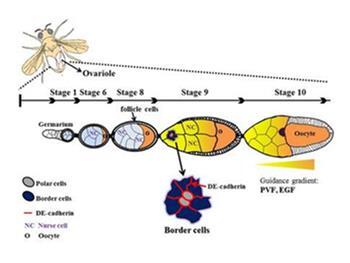 |
During development, elaborate patterns of cell differentiation and movement unfold in the correct locations and at the proper times as a result of programmed changes in patterns of gene expression. Precise spatial patterns of gene expression commonly develop in response to graded morphogens, which cause distinct patterns of gene expression at different concentrations and thereby pattern cell fates. To address this topic, we took advantage of a group of migratory cells called border cells (BCs), which are derived from the follicular epithelium and migrate collectively within the egg chamber during Drosophila oogenesis. Four to six motile cells are recruited by a pair of polar cells to form a cluster. And these extend protrusions that guide the cluster through the confined space between nurse cells to reach the oocyte. |
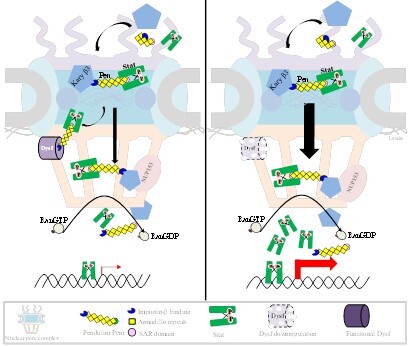 |
Collective migration is important to embryonic development and cancer metastasis, but migratory and nonmigratory cell fate discrimination by differential activity of signal pathways remains elusive. In Drosophila oogenesis, Jak/Stat signaling patterns the epithelial cell fates in early egg chambers but later renders motility to clustered border cells. How Jak/Stat signal spatiotemporally switches static epithelia to motile cells is largely unknown. We report that a nuclear protein, Dysfusion, resides on the inner nuclear membrane and interacts with importin α/β and Nup153 to modulate Jak/Stat signal by attenuating Stat nuclear import. Dysfusion is ubiquitously expressed in oogenesis but specifically down-regulated in border cells when migrating. Increase of nuclear Stat by Dysfusion down-regulation triggers invasive cell behavior and maintains persistent motility. Mammalian homolog of Dysfusion (NPAS4) also negatively regulates the nuclear accumulation of STAT3 and cancer cell migration. Thus, our finding demonstrates that Dysfusion-dependent gating mechanism is conserved and may serve as a therapeutic target for Stat-mediated cancer metastasis. |
 |
|


.svg.png)