Dr. Jiann-Ruey Hong

Dr. Jiann-Ruey Hong
Position:Professor
Group:Agriculture & Aquaculture technology group
Research Interests:Molecular virology, Cell death biology, Autophagy
E-mail:jrhong@mail.ncku.edu.tw
Room:89706
Room Tel:+886-6-2757575#58213
Laboratory Tel:+886-6-2757575#58214#710
Education
|
School |
Department |
Country |
Degree |
Period |
|---|---|---|---|---|
|
National Defense Medical Center, Taiwan |
Institute of Life Sciences |
TW |
Ph.D. |
1999 |
|
Institution |
Position |
Period |
|---|---|---|
|
Department of Biotechnology and Bioindustry Sciences, National Cheng-Kung University |
Professor |
2017~now |
|
Institute of Biotechnology, National Cheng-Kung University |
Professor |
2013~2017 |
|
Institute of Biotechnology, National Cheng-Kung University |
Associate Professor |
2008~2013 |
|
Institute of Biotechnology, National Cheng-Kung University |
Assistant Professor |
2002~2008 |
|
Institute of Molecular Biology, Academia Sinica |
Posdoctor Research Fellow |
1999~2002 |
Research Interests
The molecular death mechanisms of viruses, especially betanodavirus (Positive single-stranded RNA virus, RGNNV strain) and Iridovirus (ISKNV strain, ds-stranded DNA virus), which are capable of causing massive mortalities in larvae and juveniles of several marine teleost species worldwide. In the RGNNV-induced molecular pathogenesis mechanism, we found that RIPK3-mediated necroptosis signal is activated, which may correlated to oxidative stress induction in fish cells and grouper fish grain tissue. Furthermore, functional additive, anti-oxidative drugs NAC and DPI was used to prevent host and enhanced health in marine farm. In Iridovirus (ISKNV strain, ds-stranded DNA virus) study, has new discovery and breakthrough on Bax/Bak-mediated cell death mechanism and AKT/mTOR-mediated autophagy flux for further controlling on their diseases in clinical. On the other hand, zebrafish may use as a diseases model system. We established the zebrafish system as a model system to identify bad death gene and PSR on brain development, which also induces oxidative stress signals and autophagy flux on early embryonic development.
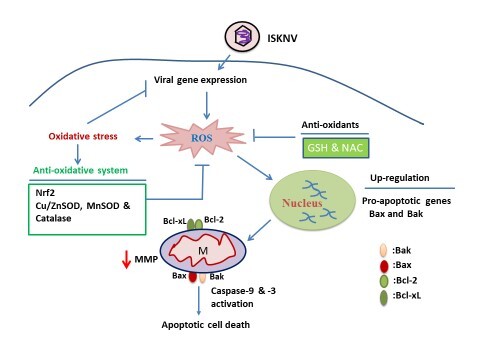 |
ISKNV infection induces mitochondria-mediated cell death that linked to viral replication has been few studied. In this study, we examined that ISKNV induced ROS/Nrf2-mediated stress signals upon intrinsic apoptotic cell death via a Bax/Bak-mediated death pathway. Then, we found that drug treatment by antioxidants could effectively suppress the ROS/Nrf2-mediated stress signal and reduce intrinsic apoptotic cell death. These findings can provide novel insights into iridovirus-regulated molecular pathogenesis and treated strategies. |
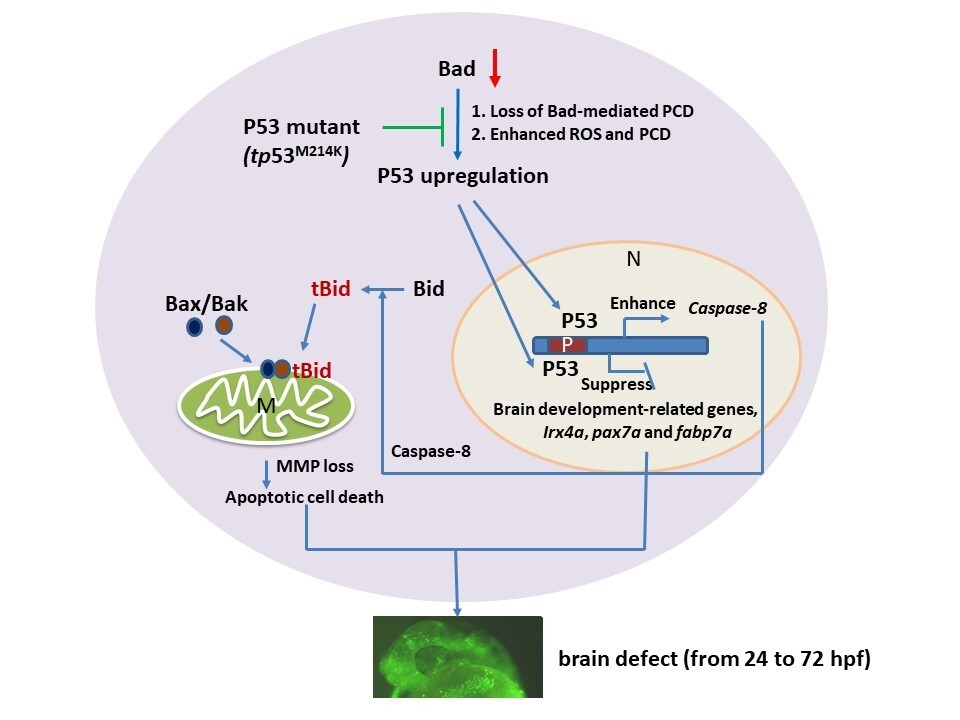 |
Recently, we found that knockdown of the BH3-only molecule Bad correlated with the upregulation of both apoptotic and oxidative stress genes. Furthermore, this Bad knockdown-mediated environmental stress can further influence normal cell migration in the formation of the three germ layers, especially the ectoderm, for further brain development, but very few studies have addressed Bad function in the molecular mechanisms of brain embryonic development. In a zebrafish system, we identified a new role for the BH3-only domain Bad in triggering PCD during early embryonic development, related to completion of the development of tissues or organs, such as the brain, by affecting some novel gene expressions during early development. These functions and the relationship between p53-mediated stress signaling on the caspase-8/tBid cell death pathway and brain-development-related regulation should all be further addressed. |
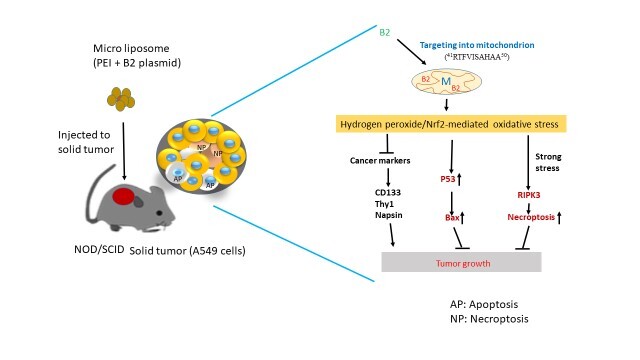 |
Our group previously used in vitro and in vivo systems (fish cells and zebra fish models) to study the B2 protein’s effect on cell death induced by ATP depletion. Nonetheless, such studies have not elucidated the function of the B2 protein on mitochondrion-mediated cell death triggering. Here, we used the novel viral B2 protein to target solid tumors and A549 lung cancer cells. Such experiments are used to study ROS/Nrf2-mediated stress signaling, which is known to induce cell death. The betanodavirus B2 protein, as a necrotic inducer, hints at a novel perspective on lung cancer therapy. |


.svg.png)