劉宗霖 教授

劉宗霖 教授
職稱:教授
研究群組:生物醫學科技產業學群
研究興趣:生物資訊、微生物基因體學
電子郵件:tsunglin@mail.ncku.edu.tw
研究室:89911
Room Tel:+886-6-2757575#58223
Laboratory Tel:+886-6-2757575#58234#911
|
學校 |
系所 |
國家 |
學位 |
期間 |
|---|---|---|---|---|
|
俄亥俄州立大學 |
物理系 |
美國 |
博士 |
2000~2006 |
|
國立臺灣大學 |
物理系 |
台灣 |
學士 |
1993~1997 |
|
機構 |
職稱 |
期間 |
|---|---|---|
|
國立成功大學生物科技與產業科學系 |
系主任 | 2026.08~迄今 |
| 國立成功大學生物科學與科技學院 | 副院長 | 2025.08~迄今 |
| 國立成功大學國際事務處國際關係組 | 組長 | 2025.08~2026.07 |
|
國立成功大學生物科技與產業科學系 |
教授 |
2023~迄今 |
|
國立成功大學生物科技與產業科學系 |
副教授 |
2014~2023 |
|
國立成功大學生物資訊與訊息傳遞研究所 |
助理教授 |
2010~2014 |
|
中央研究院生物多樣性研究中心 |
博士後研究員 |
2008~2010 |
|
美國加州大學聖塔芭芭拉分校神經科學研究所 |
博士後研究員 |
2006~2008 |
|
美國俄亥俄州立大學物理學博士 |
博士 |
2000~2006 |
|
中央研究院原子與分子科學研究所 |
研究助理 |
1999~2000 |
研究興趣
生物資訊學是一門跨領域學科,運用資訊技術精確且有效率地分析生物資料。隨著次世代定序(NGS)技術的發展,生物資訊學也快速成長,以處理不同性質且數量龐大的資料。在眾多生物資訊研究主題中,我們主要聚焦於總體基因體學與免疫受體庫分析。總體基因體學利用 NGS 探索各種環境中的微生物群落,包括人體不同部位、土壤與水體。我們與臨床醫師合作,研究人體微生物相與健康之間的關聯,例如鼻腔微生物相與兒童氣喘、口腔微生物相與漱口劑,以及腸道微生物相與發炎性腸道疾病之間的關係。我們的研究已指出多種與人類疾病相關的重要微生物。免疫受體庫則可透過追蹤獨特的 T 細胞受體(TCR)序列來描述 T 細胞的多樣性。這些獨特的 TCR 序列源自所謂的 VDJ 重組。未經重組的 TCR 序列通常因無法編碼蛋白質而被視為無功能序列,然而我們發現,未重組的 TCR 序列可作為 T 細胞淋巴瘤的生物標記。目前我們正進一步探索未重組 TCR 序列更多新的功能。
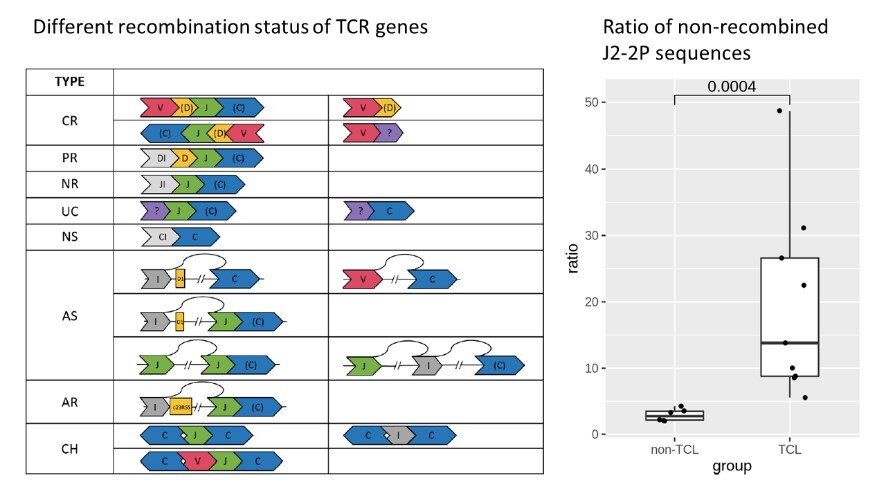 |
Clonality assessment, which can detect neoplastic T cells by identifying the uniquely recombined T-cell receptor (TCR) genes, provides important support in the diagnosis of T-cell lymphoma (TCL). BIOMED-2 is the gold standard clonality assay and has proven to be effective in European TCL patients. However, we failed to prove its sensitivity in Taiwanese TCL patients, especially based on the TCRb gene. Interestingly, we found a higher percentage (>81%) of non-recombined TCRb sequences in a TCL patient with a negative BIOMED-2 test. This suggests a new TCR target for enhancing TCL diagnosis. To further explore the hypothesis, we proposed a cost-effective digital PCR assay that quantifies the relative abundance of non-recombined TCRb sequences containing a J2-2P~J2-3 segment. With the digital PCR assay, bone marrow specimens from TCL patients (n=9) showed a positive outcome (i.e., the relative abundance of the J2-2P~J2-3 sequences ≧5%), whereas non-TCL patients (n=6) gave a negative result. As five of nine TCL patients had a negative BIOMED-2 test result, the J2-2P~J2-3 sequences may improve TCL detection. This is the first report showing the capability of characterizing non-recombined TCR sequences as a supplementary strategy for the BIOMED-2 clonality test. |
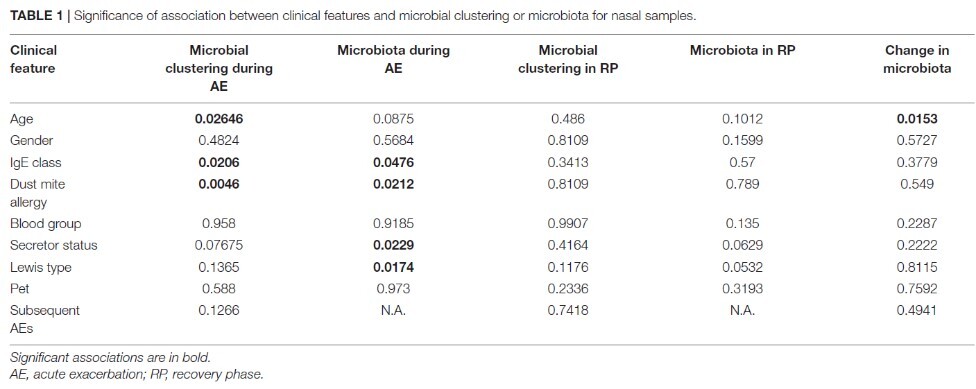 |
Airway and gut microbiota are important in asthma pathogenesis. Although several studies have revealed distinct microbiota in asthmatic airways at baseline compared to healthy controls, limited studies compared microbiota during acute exacerbation (AE) and in the recovery phase (RP) in the same asthmatic children. We aim to investigate association between microbiota and asthma status in children and explore their relationship with clinical features of asthma. Using 16S rRNA sequencing, we found that most nasal microbiota were dominated by only one or two of six bacterial genera. The domination was associated with mite allergy and patient age only during AE but not in the RP. When moving into RP, the relative abundance of Staphylococcus increased while that of Moraxella decreased. Throat and stool microbiota were not associated with most of the clinical features. Interestingly, stool microbiota during AE was associated with ABO blood type and stool microbiota in the RP was associated with frequency of the subsequent exacerbations. In summary, the association between nasal microbiota and mite allergy only during AE suggests an altered local immunity and its interplay with nasal microbes. Our work provides a basis for studying microbes, and prevention or therapeutic strategy in childhood asthma, especially during AE. |
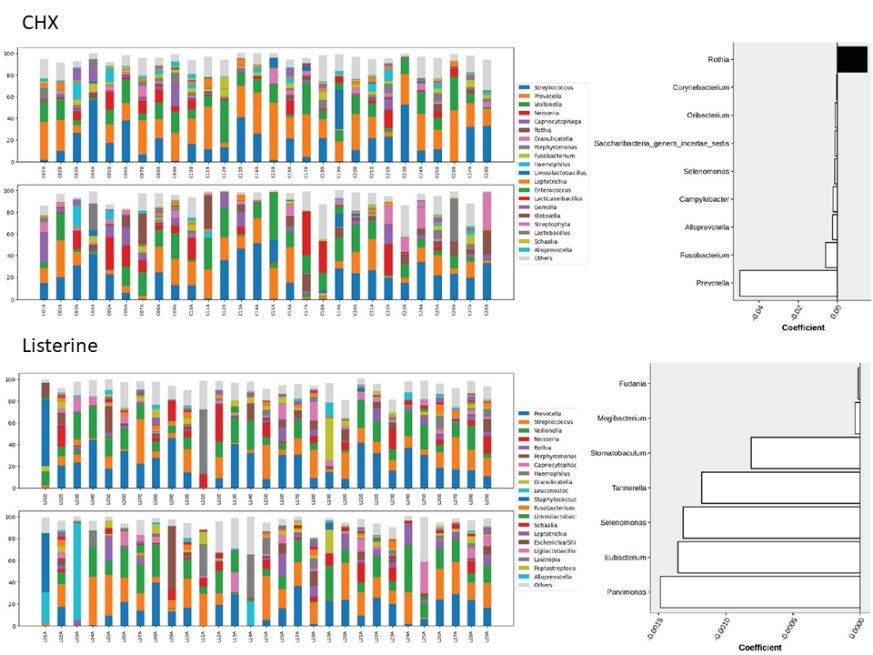 |
Chlorhexidine (CHX) and essential oil containing mouthwashes like Listerine® can improve oral hygiene via suppressing oral microbes. In hospitalized patients, CHX mouthwash reduces the incidence of ventilator-associated pneumonia. However, CHX use was also associated with increased mortality, which might be related to nitrate-reducing bacteria. Currently, no study determines oral bacteria targeted by essential oils mouthwash in hospitalized patients using a metagenomic approach, which is the aim of this work. Paired analysis revealed eight bacterial genera (including Prevotella, Fusobacterium, and Selenomonas) with a decreased relative abundance, while Rothia increased after gargling the CHX mouthwash. After gargling Listerine, seven genera (including Parvimonas, Eubacterium, and Selenomonas) showed a decreased relative abundance, and the magnitudes were smaller compared to the CHX group. Fewer bacteria targeted by Listerine were reported to be nitrate-reducing compared to the CHX mouthwash. In conclusion, short-term gargling of the CHX mouthwash and Listerine altered oral microbiota in our hospitalized patients. The bacterial genera targeted by the CHX mouthwash and Listerine were largely different and the magnitudes of changes were smaller using Listerine. Functional alterations of gargling CHX and Listerine were also different. These findings can be considered for managing oral hygiene of hospitalized patients. |


.svg.png)